 Do exactly what we did to N to get ΩBN, but this time to Σ:
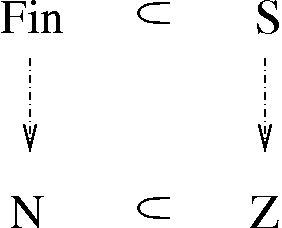
[Digression: what we did here for finite sets, could of course have been done in other similar situations. If you for instance do it to finite dimensional vector spaces, you get a version of linear algebra where you can deal with negative dimensional vector spaces. This is called topological K-theory and is useful in many situations (bundles...). If you do it to finitely generated projective modules over rings, you get algebraic K-theory which contains a wealth of arithmetic information.]
Just as you have an inclusion of N in Z, you get an inclusion of Σ in S.
S has one path component for each integer. However, now all path components are equivalent -- every component contains the information of all of Σ (you may for instance find the loop of {Ulla, Henriette} in every component of S and strangely also reappears in algebraic K-theory as the fact that the multiplicative subgroup of the integers is {-1,1} - where (-1)2=1).